

Exploration Science and Technology Laboratory
Scope
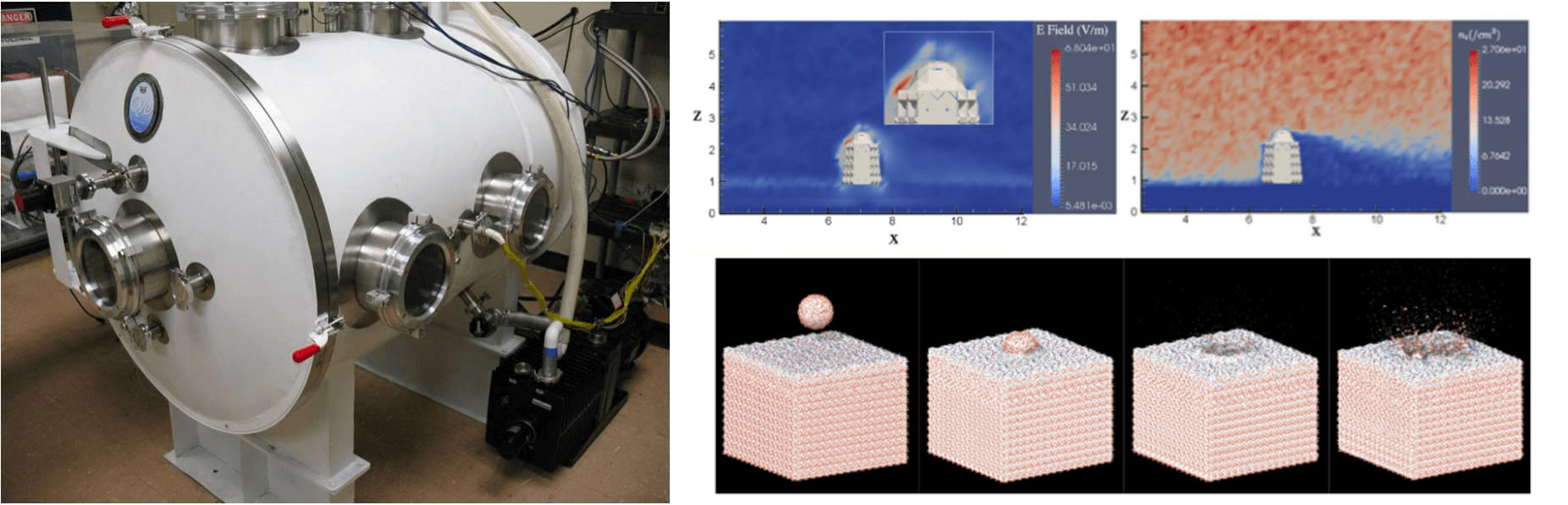
The Exploration Science and Technology Laboratory conducts fundamental and applied research across a broad range of interdisciplinary topics in space and planetary exploration. Our research expertise spans computational and experimental investigations of advanced electric propulsion, plasma interactions in orbital environments and at the lunar surface, the effects of space and planetary environments on spacecraft and astronauts, the environmental impacts of space activities on Earth, space plasma physics, and planetary science. Current research is organized around two primary focus areas: (1) space environmental science and engineering and (2) space power and propulsion.
Selected Publications
* denotes a student
K. Sampson*, M. Kapu*, N. Kelly*, I. Vielehr*, N. Tingey*, J. Torres*, D. Depew*, and J. Wang, 2026. Modeling Collision-Induced Fragmentation in Commonly-Used Ionic Liquid Propellants for Electrospray Thrusters, J. Electric Propulsion, 5(35), (2026). doi:10.1007/s44205-026-00214-9.
K. Sampson*, G. Baffour, D. Depew*, J. Torres*, N. Tingey*, K. Flynn*, A. Krylov, and J. Wang, 2026. Collision-Induced Fragmentation of the EMI-BF4 Propellant in Electrospray Thrusters: Ab initio Molecular Dynamics Simulations, J. Chem Phys, 164(16), (2026). doi:10.1063/5.0307045.
J. Asher*, K. Sampson*, and J. Wang, 2026. Experimental and Numerical Investigations of Ionic Electrospray Thruster Beam in Vacuum Chamber, J. Applied Physics, 139, 083304 (2026). doi:10.1063/5.0316722.
G.B. Pipim, K.D. Sampson*, J. Torres*, N. Tingey*, K. Flynn*, D. Depew*, J. Wang, and A. Krylov, 2025. Ab initio Simulations of Dynamics of EMI-BF4 Ionic Liquid Propellant Used in Electrospray Thrusters for Nanosatellite Applications, J. Chem Phys, 163, 224309 (2025). doi:10.1063/5.0296441.
J. Ferreira* and J. Wang, 2025. Determining Mass Fluxes of Space Debris upon Demise in the Atmosphere, Acta Astronatica, 238, part A, pp913–924 (2026). doi:10.1016/j.actaastro.2025.09.036.
J. Ferreira*, Z. Huang*, K. Nomura, and J. Wang, 2024. Potential Ozone Depletion From Satellite Demise During Atmospheric Reentry in the Era of Mega-Constellations, Geophys. Res. Letters, 51, e2024GL109280 (2024). doi:10.1029/2024GL109280. (Article highlighted by American Geophysical Union)
C. Cui* and J. Wang, 2024. Vlasov Simulations of Electric Propulsion Beam, Plasma Sources Sci. Technol., 33, 125005 (2024). doi:10.1088/1361-6595/ad98c0.
D. Depew*, G. Vaghjiani, K. Nomura, S. Parmar, and J. Wang, 2024. Liquid Structure and Hydrogen Bonding in Aqueous Hydroxylammonium Nitrate, J. Phys. Chem. B, 128(3), pp824–840 (2024). doi:10.1021/acs.jpcb.3c05623.
Z. Huang*, L. Morrissey, O. Tucker, K. Nomura, A. Nakano, and J. Wang, 2024. The Effects of the Velocity Distribution of Impact Generated Water Ice Ejecta on Exospheric Escape from Airless Bodies, Icarus, 411, 115957 (2024). doi:10.1016/j.icarus.2024.115947.
J. Wang and Z. Huang*, 2023. Multiscale Numerical Simulations of Plasma Charging Effects for Astronaut at the Lunar Terminator, IEEE Trans. Plasma Science, 51(9), pp2561–2570 (2023). doi:10.1109/TPS.2023.3295416.
Z. Huang* and J. Wang, 2023. Modeling Lunar Surface Charging under Space Weather Conditions Derived from the ARTEMIS and OMNI Data, IEEE Trans. Plasma Science, 51(9), pp2515–2521 (2023). doi:10.1109/TPS.2023.3302896.
L. Brieda, E. Helou*, and J. Wang, 2023. Towards Modeling of Charged Dust Dynamics at Mesoscale Resolution, IEEE Trans. Plasma Science, 51(9), pp2580–2583 (2023). doi:10.1109/TPS.2023.3285151.
J. Asher*, O. Acarregui*, and J. Wang, 2023. Investigation of Ionic Electrospray Contamination for Small Satellite Formation Flight, IEEE Trans. Plasma Science, 51(9), pp2508–2514 (2023). doi:10.1109/TPS.2023.3295400.
Z. Huang*, K. Nomura, L. Morrissey, and J. Wang, 2022. Molecular Dynamics Simulation of Solar Wind Implantation in the Permanently Shadowed Regions on Lunar Surface,
Geophys. Res. Letters, 49, e2022GL099333 (2022). doi:10.1029/2022GL099333.
R. Antypas*, K. Sampson*, D. Torre*, and J. Wang, 2022. Large Bradbury Nielsen Gate Optimized for Electrospray Time of Flight Spectroscopy, J. Propulsion and Power, 38(6), pp911–919 (2022). doi:10.2514/1.B38502.
J. Asher* and J. Wang, 2022. 3-Dimensional PIC Simulations of Bipolar Ionic Electrospray Thruster Plume, J. Propulsion and Power, 38(4), pp573–580, (2022). doi:doi/abs/10.2514/1.B38610.
J. Asher*, Z. Huang*, C, Cui*, and J. Wang, 2022. Multi-Scale Modeling of Ionic Electro-spray Emission, J. Applied Physics, 131, 014902 (2022). doi:10.1063/5.0071483. (Selected as featured article.)
C. Cui*, S.P. Gary, and J. Wang, 2022. Whistler Turbulence vs. Whistler Anisotropy Instability: Particle-in-Cell Simulation and Statistical Analysis, Frontiers in Astronomy and Space Sciences, 9:941241 (2022). doi:10.3389/fspas.2022.941241.
C. Cui* and J. Wang, 2021. Grid-Based Vlasov Simulation of Collisionless Plasma Expansion, Physics of Plasmas, 28, 093510 (2021). doi:10.1063/5.0058635.
Z. Huang*, K. Nomura, and J. Wang, 2021. Molecular Dynamics Simulations of Water Formation and Retention by Micrometeoroid Impact on Lunar Surface, Geophys. Res. Letters, 48(15), 2021GL093509 (2021). doi:10.1029/2021GL093509.
Recent Ph.D. dissertations
Jose Ferreira, Multi-Scale Modeling of Space Debris Demise in Earth’s Atmosphere and its Environmental Implications in the Era of Satellite Constellations, 2026.
Chen Cui, Grid-Based Vlasov Method for Kinetic Plasma Simulations, 2023. First Position: Assistant Professor, Mississippi State University. Current Position: Assistant Professor, University of Virginia.
Ziyu Huang, Lunar Surface-Environmental Interactions and Their Effects on Lunar Water Formation and Exosphere: Atomic Scale Simulations, 2023. First Position: Postdoctoral Fellow, Boston University. Current Position: Postdoctoral Fellow, Georgia Tech.
Jeffrey Asher, Numerical and Experimental Investigations of Ionic Electrospray Thruster Plume, 2022. First/Current Position: Member Technical Staff, Aerospace Corporation.
Robert Antypas, An Investigation into Magnetically Induced Extractor-Less Electrospray Propulsion Devices, 2021. First Position: Engineer, Air Force Research Laboratory. Current Position: Program Manager, Space Force.
Yinjian Zhao, Particle Simulations of Colloid Thruster Beam, 2019. First Position: Postdoctoral Fellow, Lawrence Berkeley National Laboratory.
Yuan Hu, Kinetic Studies of Collisionless Mesothermal Plasma Flow Dynamics, 2018. First Position: Research Scientist, RadiaSoft LLC. Current Position: Professor, Institute of Mechanics, Chinese Academy of Sciences.
William Yu, Numerical and Experimental Investigations of Dust-Plasma-Asteroid Interactions, 2018. First Position: Space Systems Engineer, Ball Aerospace Corporation.
Kevin Chou, Experimental Investigations of Dusty Surface Charging, 2017. First Position: Member Technical Staff, Aerospace Corporation.
R. Scott Hughes, Particle-in-Cell Simulations of Kinetic-Scale Turbulence in the Solar Wind, 2017. First Position: Postdoctoral Fellow, Jet Propulsion Laboratory. Current Position: Member Technical Staff, Jet Propulsion Laboratory
Daoru Han, Particle-in-Cell Simulations of Plasma Interactions with Asteroidal and Lunar Surfaces, 2015. First Position: Research Assistant Professor, Worcester Polytechnic Institute. Current Position: Associate Professor, Missouri University of Science and Technology.
Ouliang Chang, Three-Dimensional Kinetic Simulations of Whistler Turbulence in Solar Wind on Parallel Supercomputers, 2013. First Position: Computer Scientist, Oracle. Current Position: Senior Computer Scientist, Meta/Facebook.
John Polansky, Laboratory Investigations of the Near Surface Plasma Field and Charging at the Lunar Terminator, 2013. First Position: Assistant Professor, Kyushu Institute of Technology, Japan.
Ning Ding, Experimental and Numerical Investigations of Charging Interactions of a Dusty Surface in Space Plasma, 2012. First Position: Senior Engineer, Rigaku Innovative Technologies, Inc.